
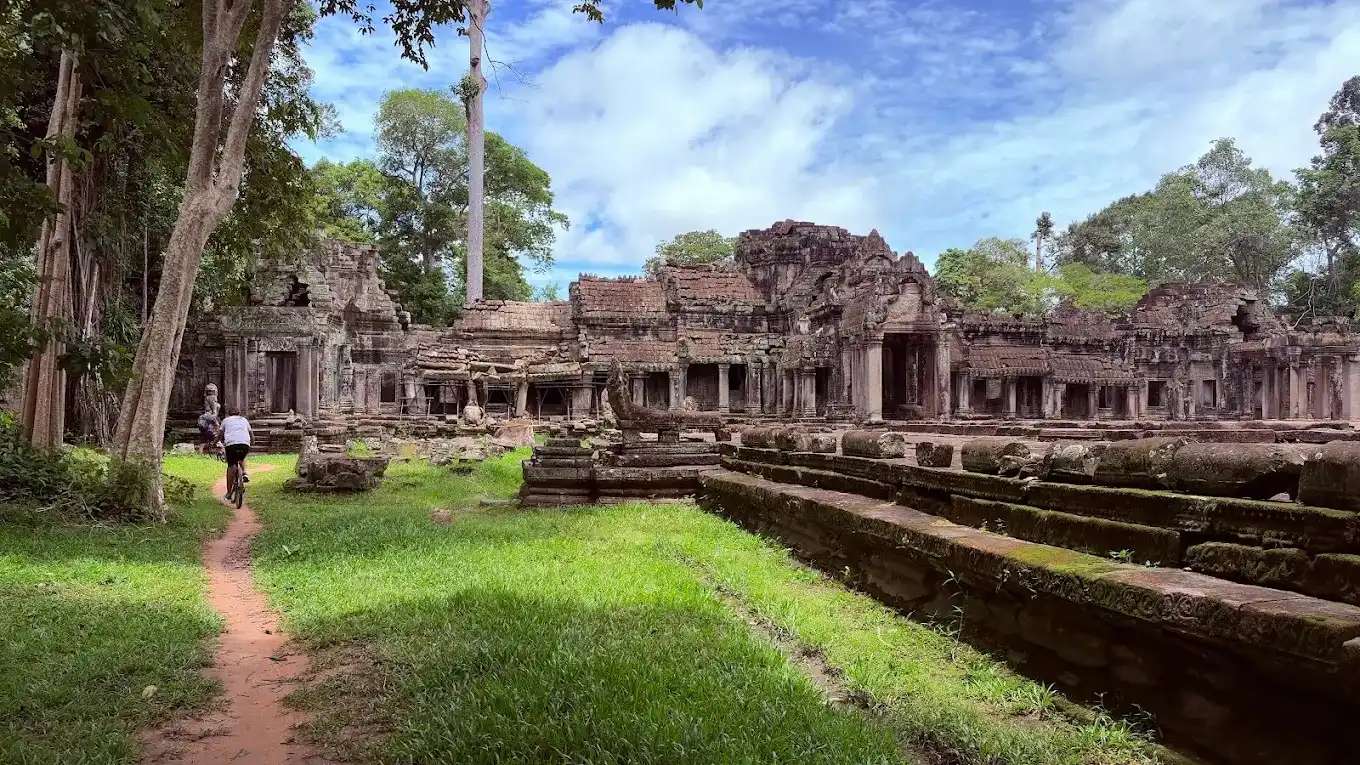
Cycling Around Angkor Wat: What to Expect When Exploring by Bike
Yes, Angkor is a very good place to explore by bike. But there is a big difference between simply cycling along the roads between the main temples and using a bike to explore the dirt tracks and forest trails that run through the area.
The second experience is the one I find much more interesting.
I have been exploring Angkor by mountain bike since 2011, originally simply because I enjoyed riding here. Over time I found my own trails, connections and quieter ways of moving between different parts of the archaeological park. Taking visitors with me came later.
That is also why I do not think of cycling Angkor Wat as following one standard route. The terrain changes, the people riding change, and the day can change with them.
One concern people understandably have is the heat. If you are standing in Siem Reap with the sun reflecting from concrete and asphalt, spending several hours on a bicycle can sound like a bad idea. On the trails, conditions can feel very different: much of the riding is under large trees and through forest, and simply moving on a bike creates some airflow.
Cambodia is still hot, of course. But the riding is often more comfortable than people expect from their experience of walking around Siem Reap.
If you are wondering whether Angkor by bike would suit you, here is what the riding is actually like.
Can You Explore Angkor Wat by Bike?
Yes, and you do not need to be an experienced mountain biker.
You should be reasonably comfortable on a bicycle, but there is a difference between needing basic bike confidence and needing advanced MTB skills.
On an off-road route around Angkor, you can encounter hard dirt, sand, roots, branches and narrower forest sections. A rider who has only cycled on roads may need a little time to get used to looking further ahead and choosing a line through uneven ground.
The sections that usually require the most attention from beginners are loose sand, exposed roots and occasional obstacles on forest trails.
None of this means you have to ride everything.
If a section of sand, mud or roots feels uncomfortable, getting off the bike and walking for a short distance is perfectly sensible. I would rather have somebody walk twenty metres than take a risk because they feel they are supposed to ride every part of the trail.
Technical difficulty and physical difficulty are also different things.
Someone can be fit but inexperienced off-road. Another rider may handle a bike very well but have less endurance. The route that works for one person may therefore be completely different from the route that works for another.
For that reason, there is no single difficulty level for cycling around Angkor. It depends greatly on where you ride, who is riding and how the day is organised.
What Is Cycling Around Angkor Actually Like?
The terrain is much more varied than many people expect.
There are broad dirt tracks where you can ride comfortably, stretches of hard-packed earth, sandy sections and smaller trails through the forest. In some places you find roots across the ground or branches and vegetation that require a little more attention.
That variation is part of the pleasure of riding here.
Roads and trails give you very different days
It is perfectly possible to use a bicycle mainly as transport between the major temples and stay largely on paved roads.
There is nothing wrong with that.
But it is very different from using the network of smaller tracks to move through Angkor.
Once you leave the main roads, the ride itself becomes part of the experience rather than simply the way you get to the next temple.
You are reading the terrain, moving through forest, changing from firm dirt to sand, following a track and occasionally emerging close to a temple after spending quite some time away from the main visitor flow.
For me, that is what makes biking Angkor Wat particularly interesting.
The temples remain important, of course. But the spaces between them start to matter as well.
Hard dirt, sand and roots
Hard-packed dirt is generally easy and enjoyable to ride.
Sand can be more surprising if you have never ridden off-road. When it is dry and loose, the front wheel can move around more than you expect. Sometimes slowing down or walking a short section is simply easier.
Roots are another feature of some forest trails. They are not everywhere and they do not turn the ride into a technical mountain-bike course. They simply require attention.
The ground can change several times during one ride, which is one reason I prefer mountain bikes for these routes.
The terrain changes with the seasons
During the dry season, the trails are generally drier, although loose sand can become more noticeable when conditions are very dry.
During the wetter months, rainfall can compact sandy ground and actually make some sandy sections easier to ride.
On other types of soil, rain can create occasional puddles or muddy patches.
That does not mean a rainy-season ride consists of struggling through mud all day. In my experience, mud is usually localised and depends heavily on the particular trail and the type of ground.
The route can be adjusted accordingly.
I go into these seasonal differences in more detail in my guide to the best time to visit Angkor Wat, because weather changes much more than just the trails.
Cycling from Siem Reap to Angkor
You can cycle from Siem Reap towards Angkor, but personally I do not think that is the most interesting use of your energy.
On my rides, we normally travel by tuk-tuk from the hotel to the start of the trail.
The idea is simple: save your legs for the part where cycling really adds something.
That means the tracks, forest and connections around Angkor itself, rather than spending the beginning and end of the day covering kilometres through town and along roads.
It also reduces exposure to traffic before the actual ride has even begun.
A typical ride with me is often somewhere around 15 to 25 kilometres, but I deliberately do not treat that as a fixed distance.
It can be shorter or longer depending on the people, the route and how the day develops.
If I am with people who do not cycle very often, I can choose easier terrain and keep the distance moderate. With fit riders who clearly want more, we can spend longer riding and use more adventurous forest trails.
The kilometres are a consequence of the day rather than its objective.
How Difficult Is Cycling Around Angkor?
For most people, I would describe the physical difficulty of a normal ride as moderate.
But that answer needs an important qualification: the route can be adapted.
If I am riding with people who have limited fitness or little off-road experience, there is no benefit in putting them onto demanding trails simply because those trails exist. We can take easier tracks, slow the pace, stop more often or shorten the ride.
With stronger riders who enjoy a challenge, I can do the opposite.
Difficulty is not created by one thing alone. There is the distance, the terrain, the amount of effort needed on softer ground and, of course, the Cambodian climate.
But heat does not feel the same everywhere.
If you judge the idea of cycling from how Siem Reap feels in the middle of a hot day, you may imagine that the ride will be exhausting from the start. On forest trails, you are often under substantial tree cover, away from the heat radiating from roads and buildings. Moving on the bike also gives you a light flow of air.
In practice, people can be surprised by how comfortable the riding feels once we are in the forest.
That does not mean ignoring the climate. Hydration, breaks and pace still matter.
The objective is not to turn Angkor into a cycling performance. Ride at a pace that lets you enjoy where you are.
Regular Bike, Mountain Bike or E-Bike?
The right bike depends on how you intend to explore Angkor.
If you mainly want to follow paved roads between temples, a normal bicycle can be sufficient.
For the type of off-road riding I do, I consider a mountain bike essential.
Wider tyres provide better grip. The bike is more stable on loose surfaces, and the front suspension helps absorb repeated vibrations and impacts from uneven ground, roots and rough sections.
That is not only about performance. It is also about comfort and control.
Some sections that are straightforward on a mountain bike would be difficult, uncomfortable or inappropriate on a typical road or city bicycle.
Even the saddle matters.
A saddle that feels perfectly acceptable on smooth tarmac can become uncomfortable after repeated vibrations on rough ground. I use more comfortably padded saddles because the bike should suit the terrain we are actually riding.
Is an E-MTB worth it?
For some riders, absolutely.
An electric mountain bike is particularly useful for someone who does not cycle regularly, wants to conserve energy in the heat or is travelling with a stronger cyclist and does not want the difference in fitness to dictate the day.
You still have a proper mountain bike underneath you. You ride the same terrain and control the bike in the same way. The motor simply reduces the amount of physical effort required.
That can make a major difference to how much energy somebody has left later in the day without taking away the experience of riding the trails.
Traffic, Crowds and Quieter Routes Between the Temples
Traffic is one of the reasons I prefer transferring from Siem Reap by tuk-tuk rather than beginning the ride in town.
Once on the trails, road sections during my rides are generally very short. We use them when there is no useful off-road connection, then leave them again.
For much of the day, traffic simply is not an important part of the ride.
The same is true of crowds, with an important distinction.
The major temples are major temples. When you arrive at Angkor Wat, Bayon or another famous site, you should expect other visitors. Riding a mountain bike does not magically make popular places empty.
Between those sites, however, the situation can be completely different.
On many of the small forest tracks I use, it is common to ride for long stretches without meeting another tourist. Sometimes we encounter Cambodians working in the forest. Often we encounter almost nobody.
There are also smaller temples that receive very few visitors and can sometimes be extremely quiet.
So when I talk about quieter Angkor cycling, I am not promising an archaeological park without tourists.
It is more about changing the proportion of your day that is spent in the main visitor flow.
Sometimes the calmest and most memorable part is not the temple where you stop. It is the trail that brought you there.
Cycling Angkor Independently or With a Guide?
You can absolutely explore Angkor by bike independently.
If you are comfortable organising your own day and mainly intend to use the established roads between the principal sites, there is no reason to pretend that a guide is required.
A guided cycling tour can also mean very different things, though.
Before choosing one, it is worth looking beyond the words “bike tour” and asking how the day actually works.
- Is the booking private, or will you join people you do not know?
- Is the route fixed, or can it change according to your level?
- How much of the ride is on roads and how much is off-road?
- What kind of bicycles are used?
- What happens if one person gets tired while everyone else wants to continue?
- Can the route be made easier, harder, shorter or longer during the day?
These things may look like details when you are comparing tours online. On the bike, they can change the experience considerably.
My own rides grew out of cycling Angkor for pleasure long before I started taking visitors with me. The trails came first, and guiding developed from wanting to share the places and routes I already enjoyed.
Because each booking is private, I can adjust the terrain, distance and pace to the people I am riding with rather than making one fixed circuit work for everyone.
For me, knowing the trails is only part of guiding. The other part is being able to change the day when necessary.
What Should You Bring?
Cycling clothes need to work for both riding and visiting sacred sites.
Angkor’s official visitor rules require shoulders and knees to be covered in sacred places. This is worth planning for, especially if you prefer to ride in lighter or shorter sports clothing.
You do not necessarily need to spend the whole ride in long clothes. A practical option is to carry a light sarong or another easy cover-up that you can put on when entering temples where more modest clothing is required.
Light, comfortable clothing that gives you some protection from the sun works well, and hydration remains important throughout the day.
In wetter periods, accepting that you may encounter rain, a puddle or a muddy patch is simply part of doing an outdoor activity.
On my rides, the bike, helmet, gloves, water, snacks and lunch are provided, along with tuk-tuk support during the day.
The Angkor Pass itself is not included.
What Happens If You Get Tired?
This is an important question, especially for couples, families and small groups where everybody does not have the same fitness level.
One person getting tired does not mean everybody has to stop.
A support tuk-tuk is available during the day, with a trailer that can carry the bikes.
If somebody has had enough, we can put their bike on the trailer and they can return to the hotel while the rest of the group continues riding.
That means you do not need to know in advance exactly how many kilometres everyone will manage. A less confident rider also does not have to spend the morning worrying that they will eventually hold everyone else back.
If everybody wants more, we continue.
If somebody wants less, we adapt.
That flexibility is particularly useful when people in the same group have different levels.
Is Cycling Angkor Wat Right for You?
Cycling around Angkor is particularly rewarding if you like the idea that getting from one temple to another can be part of the experience rather than dead time between visits.
You do not need advanced mountain-bike skills.
You do need to be comfortable on a bicycle, willing to ride on changing surfaces and happy to treat a little sand, a root or an occasional muddy section as part of an outdoor day.
If you are an occasional cyclist, the route can remain accessible.
If you are fitter and want more adventure, there is room to make the riding more demanding.
And if you simply want to explore independently on the main roads, that is possible too.
There is no single correct way to cycle Angkor.
If the kind of riding I have described here sounds like what you are looking for, you can read more about my private mountain bike tour around Angkor, or ask me about your group before deciding.