
Best Time to Visit Angkor Wat: Weather, Crowds and Cycling Conditions
If you want the simplest answer, December, January and February are probably the easiest months to recommend for visiting Angkor.
The weather is generally cooler and drier, there is plenty of sunshine, and spending several hours outside is simply more comfortable.
But that does not mean the rest of the year is a bad time to come.
November can be particularly attractive because the landscape is still very green after the rainy season while the weather is already becoming cooler. March remains pleasant too, although the heat is starting to become more noticeable.
And the rainy season is much more interesting than the simple idea of “bad weather” suggests.
For me, the useful question is therefore not only “What is the best month to visit Angkor Wat?”
It is also: what kind of conditions do you personally enjoy when you spend a full day exploring Angkor outdoors?
In short
- December to February is the easiest period to recommend for cooler, drier conditions.
- November is also excellent, with cooler weather and greener landscapes after the rains.
- March is still pleasant, but the heat is beginning to become more noticeable.
- Rainy-season showers are often short and very heavy, while the landscape becomes much greener.
- If I had to choose one month personally, I would probably choose February.
When Is the Best Time to Visit Angkor Wat?
For most visitors, I would put the strongest period somewhere between December and February.
Those months combine several advantages: cooler conditions, generally dry weather and a lot of sunshine.
If you are walking through temples for hours, climbing steps, spending time outside or riding a bicycle, that difference in temperature matters.
November is slightly different.
It still feels connected to the end of the rainy season. The vegetation is often very green, the countryside still carries a lot of water, and at the same time the weather is already becoming cooler.
March sits at the other end of the transition.
It is generally dry and sunny, but you begin to feel the hotter part of the dry season approaching.
So I would not describe one date as the only correct answer.
But if somebody asked me for the easiest period to recommend without knowing anything else about them, December, January and February would be at the top of the list.
If I had to choose one month for myself, I would probably choose February.
November to March: Cooler and Drier
This is the period most people imagine when they think about the best season for Angkor, and there is a good reason for that.
The main advantage is not simply that there is less rain. It is that spending a long day outdoors becomes easier.
You can walk between temples, stop to explore, spend time in the forest and remain outside for several hours without the heat dominating every decision.
December, January and February are the months I find particularly comfortable.
The trade-off is that they also coincide with the busiest part of the tourist season.
December and January in particular can feel noticeably busier around the most famous temples.
That does not mean every part of Angkor suddenly feels crowded.
There is a big difference between standing at one of the major monuments and moving along small forest tracks or quieter connections between sites.
On the routes I use by mountain bike, the difference in visitor numbers is much less important because many of those trails simply do not carry the same tourist traffic.
April and May: Hot Season
By April and May, heat becomes a much more important part of the day.
That does not make Angkor impossible to visit, but it changes how you should approach several hours outdoors.
Hydration matters more. Breaks matter more. Pace matters more.
I do not automatically shorten every ride or insist on a completely different schedule simply because it is hot.
I adapt the pace, the route and the number of stops to the people I am with and to how the conditions actually feel that day.
There is also an important difference between being in Siem Reap town and being inside the forest around Angkor.
In town, you feel the sun directly and you also feel heat coming back from concrete and asphalt.
On many of the trails I ride, large trees provide substantial shade. When you are moving on a bicycle, you also create some airflow.
It is still hot. I would never pretend otherwise.
But the heat can feel surprisingly different once you are moving under the trees rather than standing on an exposed road in town.
Rainy Season: Better Than Many Travelers Expect
The rainy season often sounds much worse from a distance than it feels when you are actually here.
In practice, the rain often arrives as a short, very heavy tropical shower rather than hours of continuous drizzle.
It can feel almost as if someone has turned on a giant shower for a while.
Inside the forest, the canopy softens part of that rain. You still get wet, of course, but the experience is different from being caught completely in the open.
And sometimes it is simply fun.
You wait it out, ride through it or accept that getting wet is part of the day. The forest changes around you, the ground changes, and the ride becomes a little more adventurous.
If you take it in that spirit rather than expecting every hour to be perfectly dry, it can be a very enjoyable way to experience Angkor.
The ground changes too.
Some sections can become muddy or less interesting after rain, while other sandy sections actually become easier because the water compacts the soil.
I do not have one season when all my routes suddenly become unusable.
It depends on the particular trail and the type of ground, so I simply adapt the route when necessary.
I would not say the rainy season is better than the dry season.
It is simply different.
If your priority is predictable dry weather, December to February is the easier choice.
If you enjoy greener landscapes and do not mind an occasional tropical shower, the wet season has a character of its own.
What Is the Best Time of Day to Visit Angkor Wat?
There is no single best hour for every temple, but the atmosphere changes noticeably during the day.
I like the energy of the morning.
Around 10 or 11 o’clock, the day is properly underway and there is still a feeling of morning activity before the middle of the day becomes more dominant.
Late afternoon has a different quality.
From around 4 p.m., depending on the season and conditions, the light starts to become warmer as the sun gets lower.
Photographers often call this the golden hour, and around Angkor that yellow-orange light can be particularly beautiful on stone, trees and temple walls.
If photography matters to you, late afternoon can therefore be a very rewarding time to be outside.
Sunrise is obviously famous at Angkor Wat and many visitors want to experience it.
But it is not the only interesting time of day, and I would not organise an entire visit around sunrise unless that particular experience is important to you.
How the Seasons Affect Cycling Conditions
Seasonal differences become much more tangible once you leave the paved roads.
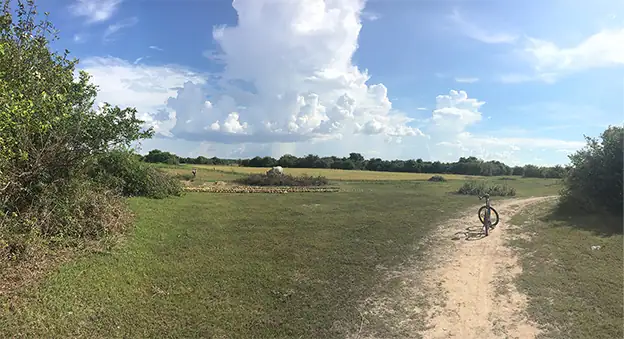
In very dry conditions, sandy sections can become looser. The front wheel can move around more, and some sections require more attention.
After rain, the opposite can happen.
Water can compact sandy ground and make those same sections easier to ride.
Other types of soil may become muddy or develop puddles, but those conditions are usually local rather than something that defines every kilometre of a rainy-season ride.
Roots, vegetation and the surface of smaller tracks also change throughout the year.
The important thing is not to imagine that one fixed route has identical conditions every month.
I choose or adjust trails according to what the ground is actually like.
If you want a fuller picture of the terrain itself, I explain it in more detail in my guide to cycling around Angkor Wat.
What changes with the season is not whether Angkor can be ridden, but which conditions you are riding through.
When Is Angkor Less Crowded?
There is a real seasonal difference in visitor numbers.
December and January are part of the main tourist season, and the best-known temples can be noticeably busier.
But season is only one part of the answer.
The temple you visit, the time of day and the way you move through Angkor can make just as much difference.
Angkor Wat, Bayon and other major sites attract visitors throughout the year.
A smaller temple or a forest track between the main sites can feel completely different, even during a busy month.
That is particularly noticeable by bike.
On many of the trails I use, there may be very few tourists regardless of whether it is high season or low season.
So I would not choose a month solely because somebody promises “no crowds”.
There are too many variables for that to be a useful promise.
So, When Would I Choose to Visit?
If I were choosing purely for comfortable weather, I would choose December, January or February.
February would probably be my personal first choice.
If I wanted cooler weather but also liked the idea of seeing Angkor and the surrounding countryside while everything was still particularly green, I would look seriously at November.
If I did not mind more heat, March would still be a very pleasant option, although you begin to feel the dry season becoming more intense.
And if I enjoyed tropical landscapes, denser vegetation and the possibility of a sudden shower turning part of the day into an adventure, I would not dismiss the rainy season at all.
There is a trade-off in every period.
The coolest and driest months are also among the busiest.
The wetter months are less predictable, but they change the landscape completely.
The hottest months demand more from you physically, but Angkor itself does not stop being worth exploring.
For me, that is a more useful way to choose than looking for one universal “perfect” month.
There Is More Than One Good Time to Visit Angkor
If you can choose freely and want the easiest answer, come between December and February.
If your dates fall outside those months, I would not worry too much.
Angkor changes throughout the year, but those changes are part of what makes spending time outdoors here interesting.
Dry trails, compact wet-season sand, tropical showers, greener rice fields, warmer afternoon light and busier or quieter temple visits all produce slightly different versions of the same place.
If exploring Angkor by mountain bike sounds like the kind of day you would enjoy, you can read more about my private mountain bike tours around Angkor or ask me about your dates before deciding.